Showing posts with label observing. Show all posts

Tuesday, April 1, 2014

Observing report 3/20 and 3/24

Orion over the observatory dome, 3/24.
Monday and Thursday labs completed their first observing sessions. Everybody had a celestial sphere orientation, tour of the observatory, and a telescope view of a few objects (Orion Nebula, M67 from the HR Diagram Lab, and Jupiter). Clouds rolled through during on Thursday evening, but all sessions had at least some clear skies.

We attempted a timelapse of circumpolar motion, but mostly we got clouds!

Wednesday, November 27, 2013

Astro 101 Observing Session 2

Venus setting, in the handle
 of Sagittarius' "teapot."
Here is a combined report for observing session 2 for the Monday and Thursday AST101 labs. We were delayed by bad weather but eventually got out on November 14 and 18. On both evenings, we concentrating on digital imaging. First we tried some afocal photography, which amounts to holding a camera up to the eyepiece of a telescope and snapping a photo. It can work well, even with a cell phone, for bright objects like the moon or a planet.
L to R moon pics by Sarah Scott, Rorie Lentz, Megan Haugh, and Ali Cooke.
Sarah's photo was the College photo of the day on 11/26!
We also took some time lapse image sequences of the sky using a Canon point-and-shoot camera running the Canon Hack Development Kit. Here is one of the better results, a video compiled from images of the northern sky taken each minute for about two hours.

Finally, we took images through a Meade 8" telescope using and SBIG 402 CCD camera. The best results are below:

Globular cluster M13, unfiltered.
Planetary nebula M27, combination of 3 images using
red, blue, and green filters.
M92, another RGB combination


Tuesday, February 19, 2013

Astro 102 Observing Report, 2/18

Lining up to see the moon.
Monday lab finally got their turn at the observatory last night. Some high clouds were a a problem, especially around 8:00 but nothing bad enough to keep us from our appointed tasks. Our sessions consisted of a visual sky tour and celestial sphere orientation. Then we looked at the crescent moon and Jupiter through one of the 8" scopes. Seeing was good. Cloud belts and all four Galilean moons were visible. We then looked at the Great Orion Nebula, a starforming cloud over 1,000 light years away. We had telescopic views of Rigel (B8) and Betelgeuse (M2) to see a contrasting pair of spectral types. We concluded each of the two sessions with a brief tour of the observatory building.

The high clouds did cause a moon halo for a while, seen below. It's caused by hexagonal ice crystals and always appears 22 degrees from the moon. Orion (lower left), Jupiter (right of the moon), and the Pleiades (farther right) are all visible. Note that the moon, which was just past first quarter, is overexposed to allow the  fainter halo to be photographed.


Saturday, February 16, 2013

Astro 102 Observing Report

Big Dipper over the observatory dome. 30 sec exposure.
Waxing crescent moon, overexposed to show earthshine.
Astro 102 lab, Thursday section, enjoyed a decent night at the Gettysburg College Observatory, Thursday, February 14. Skies were a little hazy, but remained clear for the duration of our sessions. Mercury was still visible above the hill in the west as I arrived about 6:30 PM, but it had set by the time students arrived. Our sessions consisted of a visual sky tour and celestial sphere orientation. Then we looked at the crescent moon and Jupiter through one of the 8" scopes. Seeing was fantastic. As an experienced observer, I found four cloud belts easily visible. All four Galilean moons were gathered on the same side of the planet. We then looked at the Great Orion Nebula, a starforming cloud over 1,000 light years away. We then had telescopic views of Rigel (B8) and Betelgeuse (M2) to see a contrasting pair of spectral types. We concluded each of the two sessions with a brief tour of the inside of the observatory.

Friday, November 9, 2012

Observing Report 11/8

The 7 PM session at the Meade telescope,
Jupiter rising in the background.
Thursday lab was fortunate to have very clear (but cold!) skies for their second observing session. Both 7 and 8 PM groups had a sky tour, looked at Jupiter and moons through a Meade 8" telescope, and then focused on taking an image with the SBIG 402 CCD camera. The 7 PM group also got a look at what Dr. Marschall was doing with the research telescope. Here a some of the results of our labors. The targets were globular cluster M15 and planetary nebula M27.


M15, unfiltered, 24-sec exposure.
M15, combo of 3 16-sec exposures through RGB filters.

M27, combo of 3 18-sec exposures through RGB filters.

Tuesday, November 6, 2012

Observing Report: Nov 5, 2012


Monday lab had a clear but cold second session at the observatory.  (In the video above, you can see darkness fall at the observatory before the lab session at 24x natural speed.) The focus of the session was imaging, though we also had a visual sky tour and a telescopic view of Juipter, which was visible above the eastern horizon by 7:30.

Big Dipper in the NNW, 6:20 PM

Bright objects L-R Capella, Jupiter, Aldebaran. 8:30 PM

We used an SBIG 402 CCD camera to image one deep space object in each session. In the 7:00 session, we took pictures of M57 (the Ring Nebula) and at 8:00 the target was M27 (the Dumbell Nebula). In both sessions we took both unfiltered images and a set of images through RGB filters to later combine into a color image. Here are the results:
M27, unfiltered, 24 sec exposure. Not focused as well as we thought. Color results were  not satisfactory.

M57, unfiltered, 12 sec exposure.

Combinations of three 12 sec exposures through red, blue, and green filters. Best of the night!


Thursday, October 18, 2012

AST 101 Observing 10/4

Setting up.
Here are a three photos from the Astro 101 observing session on Thursday, Oct. 4.

Sorry about the focus, but I wanted to include it. Of the two bright reddish objectrs, Mars is on the right and the  star Antares on the left. 7:30 PM EDT.

Cassiopeia and Perseous over the GCO dome. 8:30 PM, 60 sec. exposure.

Monday, October 1, 2012

Observing Session, Sept 24

 Here are a couple photos from a recent Astronomy 101 observing session. The first shows the waxing gibbous moon above campus before students arrived, and the second shows student activity on the observing deck during a thirty second exposure.

Wednesday, June 6, 2012

Venus Transit Report

7:17 PM, transit underway, sun going behind the trees.
The transit of Venus early Tuesday evening was the eighth such event since the invention of the telescope. The first in 1631 was predicted, but so far as we know, not successfully viewed by anyone. In 1639 two people saw the black ball of the planet Venus glide slowly across the face of the brilliant sun. About a hundred saw the transits of 1761 and 1769, by which time efforts were being made to time the event and thus determine the scale of the solar system. In 1874 and 1882, when thousands viewed, the United States spent over $300,000 dollars (not adjusting for inflation) on expeditions to time the transit. Though the scale of the solar system has long been fixed by other means, millions saw the transits of 2004 and 2012 live, at least if you count second-hand viewing by means of media. (Sources: Guy Ottewell's Astronomical Calendar for the  numbers of viewers and a lecture by Laurence Marschall for the expenditure.)

Not looking good.
Here at Gettysburg College, about 150 fortunate souls got to see a transit of Venus first hand. For those who organized the event (Jackie Milingo, Dick Cooper, Mike Hayden, and me), disappointing memories of 2004 were fresh. The transit of that year was a morning happening, already in progress at sunrise. A thick fog hung over Gettysburg, and before it burned off, the transit had ended. No one there saw a thing. The transit this Tuesday occurred at the opposite end of the day, beginning just after 6:00 PM and still not halfway over at the time of local sunset. To narrow our chances a bit further, there is a wooded hill to the west of the observatory, and we knew the sun would dip behind those trees well before the official time of sunset. Clouds dogged us through the day. As the staff arrived to set up, the skies turned mostly sunny, only to be followed by a band of thick clouds that closed in around 5:30, just as dozens were arriving at the observatory. Their time on this pale blue dot would be up before the transits of 2117 and 2125, but the only remedy was to put a NASA webcast on a laptop and hope that it would not turn out to be their only view of the event.

Watching the webcast.
As the transit began, the webcast (difficult to see outdoors and frequently buffering) was all we saw. We noticed nothing on the image at first contact, but after several minutes, we could see a tiny dent in the edge of the sun. By 6:30 the whole of the planet Venus was enclosed by the backdrop of the sun, but still only on the webcast. All those outside the observatory were watching a blue patch of sky in the northwest moving excruciatingly slowly toward the sun, and hoping it would get there before the sun went behind the trees. There was no denying that the crowd was getting a bit tense.

"We've got Venus!"
Lines at the scopes.
The wait did pay off. The clouds pulled away from the sun, partially at first. We tweeted "#VenusTransit success @gettysburg!" from @GCPlanetarium at 6:37 when the faculty members supervising the solar-filter equipped scopes got their first glimpses of the sun with the transit in progress. Lines formed behind every active viewing station, but it soon became clear that that sun would remain in the big patch of blue sky until it set, and there would be no hurry. At the peak of activity, people went from view to view, looking in eyepieces or at projections, holding small children up to do the same, and snapping pictures with cameras and cell phones. I took the last picture from the observing platform at 7:17 through the eyepiece of a telescope (see top of post). It shows the sun, partly covered by unfocused leaves, but the spot that is Venus is still visible above them. Then the crowd almost all drifted away and a we started to pack up. A handful of new people walked up, local listeners of WZBT, the college radio station that had promoted the event. I was about tcommiserate with their bad timing when I took a moment to look around and realize the obvious: the athletic practice fields just to our east were still bathed in sunlight. I picked up one of the cased-up Sunspotters and we walked into the sunlit field for their only view, and my last one, of planet Venus against the sun.
Astroscan (red) and projection box.


Cooper with successful video setup.
If you are wondering about the technical side of things. here is what we had set up - all comericially available equipment, some of it quite old. Three 8-inch Schmidt-Cassegrain telescopes (one Celestron and two Meades) with standard solar filters; one Celestron 5 with video eyepiece and monitor; one Edmund Astroscan projecting into a cardboard box (the box shields the faint image); and two Sunspotters, purpose-made solar projection telescopes. As we put it all away, Mike Hayden joked that we should carefully label everything for use in 2117.


7:32 PM, a final look.


Friday, February 10, 2012

Observing Report: Thurs, Feb 9

Jupiter and Venus (below) above the GC Observatory dome.
 Thursday lab had a good session at the observatory, if a bit cold (28 F at the end of the second session). Both the 7 and 8 PM groups had a sky tour, including celestial sphere concepts, Jupiter and Venus in the west, and bright stars and major constellations of the season (Ursa Major, Orion and the Winter Oval, Pegasus and more). We used Meade telescopes to observe Venus, Uranus (less than one degree away!), the Orion Nebula, star clusters M37 and M35, and the Andromeda Galaxy. Before the 8 PM session was over, Mars and the waning gibbous moon were rising in the east. Both session finished with a tour of the observatory (CCD carts, research telescope, control room). We're looking forward to going out again later in the semester and hopefully using the CCD cameras to take some telescopic images. All images here by Ian Clarke with a Panasonic FZ-100.
From lower L to upper R: Orion, the Hyades, and the Pleiades.
Uranus (L) and Venus.

Mars and the moon.

Tuesday, February 7, 2012

Astro 102 Observing Lab, Monday, 2/6

Photo by Ian Clarke
Monday lab had a good session last night, though a little cold. After a visual tour of the sky (dominated by the almost-full moon), we used a Meade telescope to observe Venus, Jupiter, the Orion Nebula, the Andromeda Galaxy and the moon. A look at the dome room and control room of the observatory building wrapped up the evening. The image on the right, taken at 6:38 PM, shows Jupiter (above), Venus (below), and the observing deck illuminated by moonlight. Look for Venus and Jupiter to draw closer together over the next few weeks, eventually passing about three degrees from each other on March 12.

Friday, December 2, 2011

November Observing Photos

 We got the CCD cameras out at our second session. Here are photos of M13 (globular cluster) and M27 (planetary nebula):


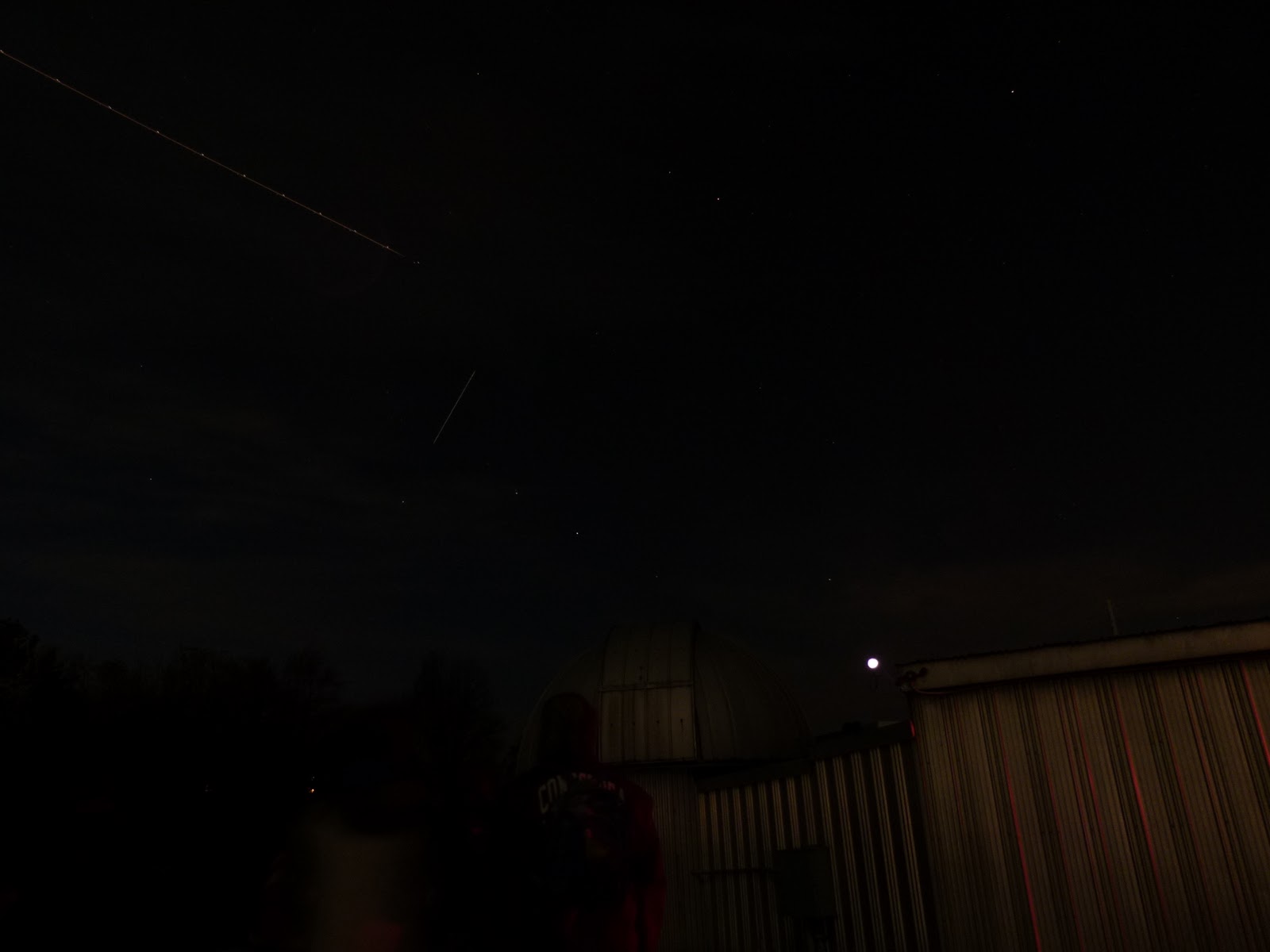
And finally, another shot of the Int'l Space Station. It's the short trail; longer trail is an airplane.

Tuesday, October 18, 2011

Astro 101 Observing 10/17

Here are some photos taken on and around the observing deck at our session Monday night. The first two show the International Space Station, which passed over just before our first session. First shot is of the ISS appearing and moving up in the southwest, the next is shows it at max altitude and brightness (mag -3.3). Both are 15 sec exposures. The last shows Jupiter rising over the GC Observatory. It's a 30 sec exposure on an ordinary tripod with no tracking, so if you zoom in you can see that Jupiter and the stars moved during 30 seconds of the earth's rotation! Note the Pleiades just to the right of the observatory dome.


Posted by Picasa