After a bit of a hiatus, the Hatter Planetarium and WZBT astrominute returns! Since the college astronmy folk were all together at "planetarium camp," something strange happened:
http://public.gettysburg.edu/~iclarke/hatter/podcasts/astrominute071316.mp3
Next astrominute should be posted around the middle of August.
Saturday, July 16, 2016

6 from Gettysburg Attend Spitz Institute

Twitter followers of @GCPlanetarium know that some of us spent the last week in Chadds Ford at the Spitz Institute. Conducted by the makers of both our 1966 and 2016 planetarium systems, this annual training and skills development session was crucial for us to get to know the new system and to learn some of the many, many ways we can use it to benefit our astronomy students, students and faculty of the College as a whole, and the public. Summing up what we learned is more than I can do in this brief post, so for now I just want to acknowledge those who attended: Jackie Milingo, astronomy professor and the driving force behind the re-invention of the Hatter Planetarium; Ryan Johnson, astronomy professor and the first user of the new planetarium as a classroom; Eric Remy, Director of Instructional Technology at the College; Craig Foltz, astronomy lab instructor and retired observatory director and NSF administrator; and your humble correspondent, Ian Clarke, Planetarium Director and astronomy lab instructor. Thank you to all just mentioned, and to Spitz and Gettysburg College for the incredibly valuable week!
Dark Skies in the PA Backcountry
 |
| Looking south from a campsite in the Hammersley Wild Area. |
 |
| Modified snip from darksitefinder.com |
three dark sky areas: the Adirondacks, an area round the VA-WV border, and north-central Pennsylvania. This is the sparsely populated area sometimes called the "Pennsylvania Wilds." It includes Cherry Springs State Park, a designated dark sky park that is managed to provide a place for astronomy. But of course much of the area around Cherry Springs is equally dark and sometimes more remote. If you want a backcountry experience in this heavily wooded region that includes dark skies, you are mostly limited by the view.
 |
| Campsite before dark. |
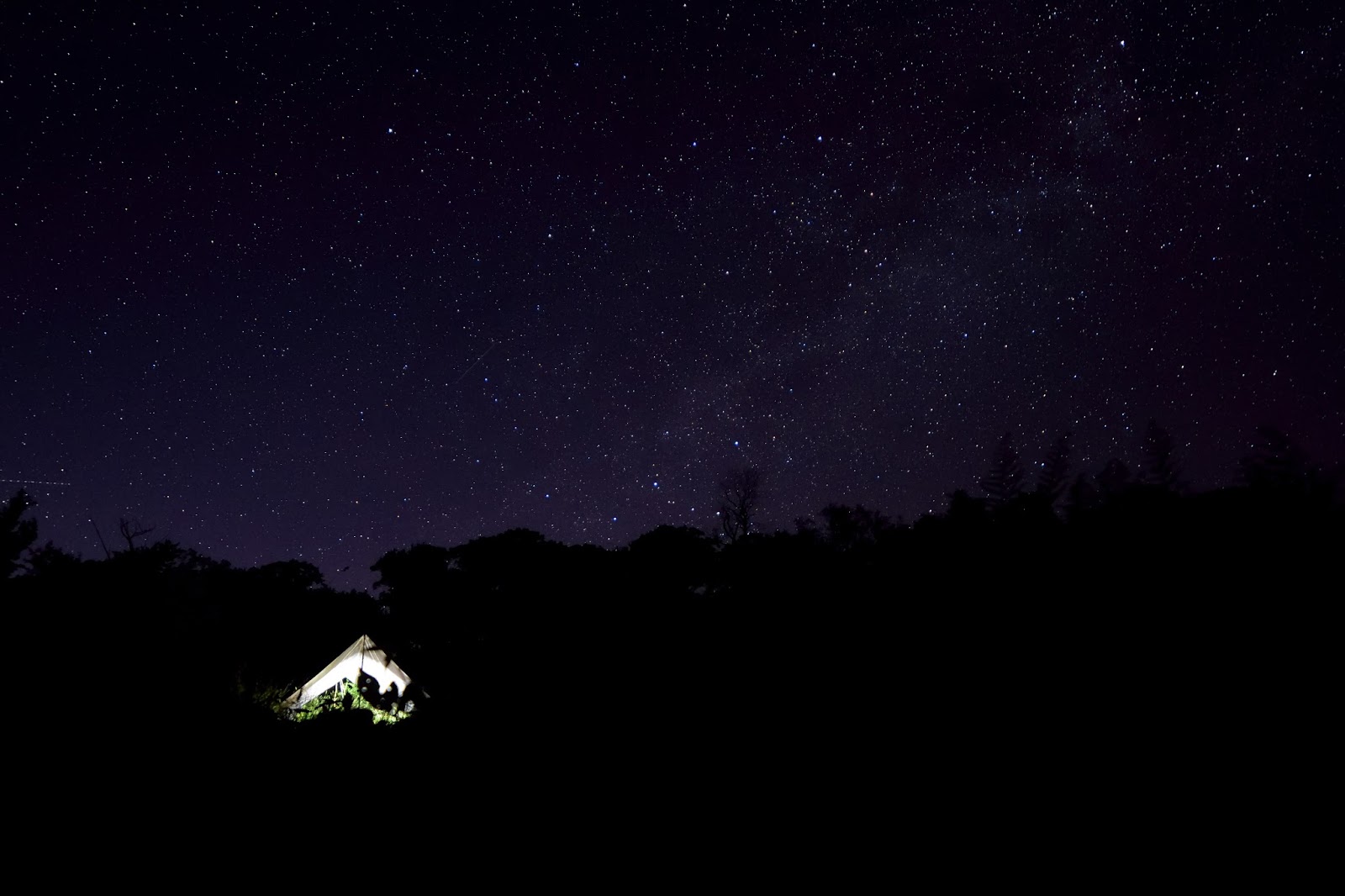
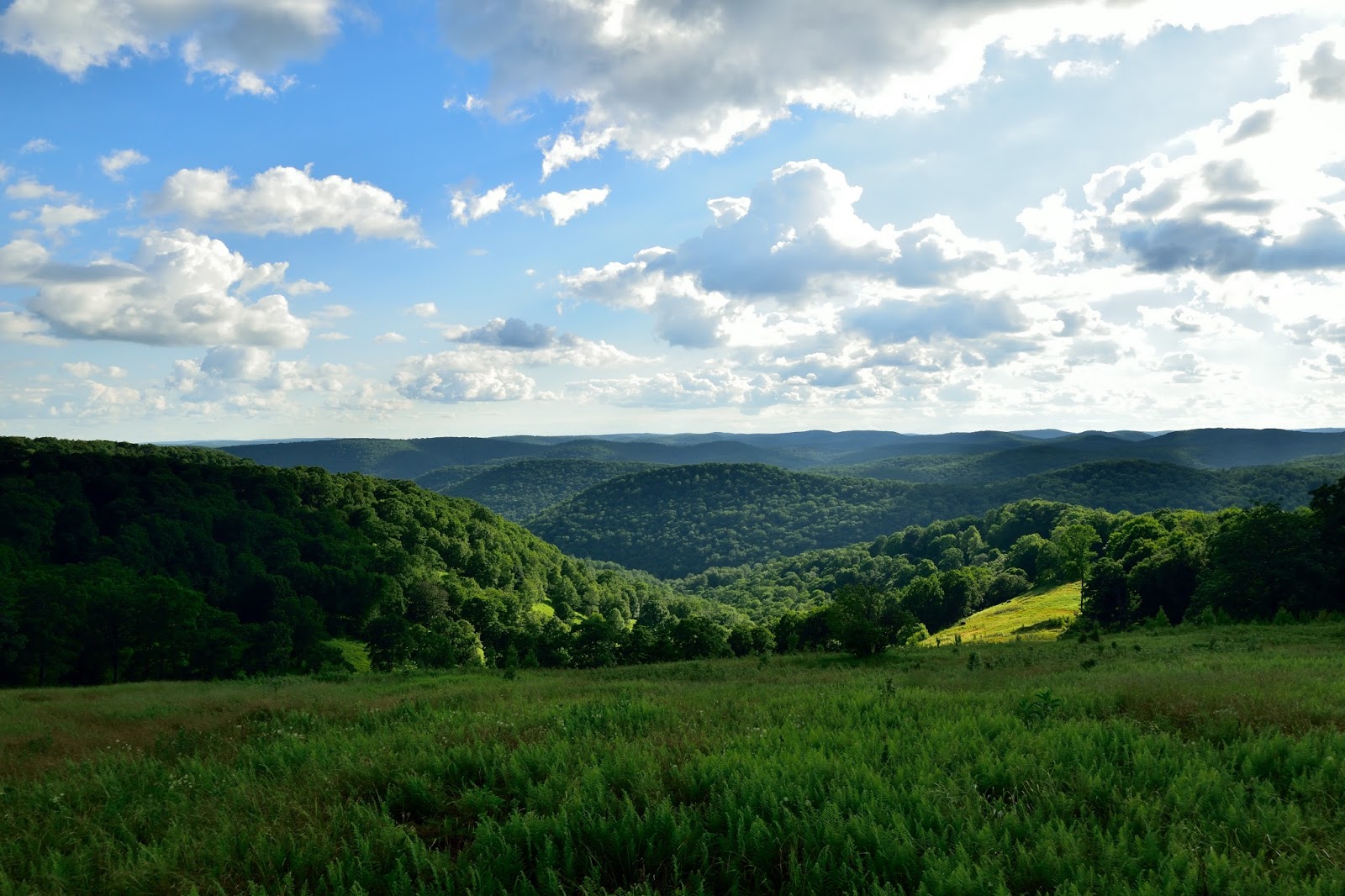
On the afternoon of June 29, I hiked into the Hammersley Wild Area, largest roadless area in Pennsylvania. I know of a few lovely meadows in the Hammersley down near the headwaters of the Hammersely Fork, but on this evening I was headed for higher ground - a clearing that was the site of a 1964 forest fire. (It's well-described in this hike write-up.) The night sky did not disappoint! The moon phase (waning crescent) had the moon below the horizon for most of the night, and the full band of the Milky Way was strikingly bright from horizon to horizon. The Andromeda Galaxy, when it rose, was evident without the least bit of hunting.
I certainly don't consider myself a photographer, but I could not let the trip go without documentation. These images were taken with a Nikon D5300 and a Rokinon 14mm wide angle lens on a mini-tripod. Exposures were 20-25 sec, and raw images were processed with ViewNX 2.
 |
| Looking northeast: Delphinus is over the peak of the tarp. |
 |
| Looking north after darkness falls. |
 |
| Hammersley Wild Area |
Saturday, July 2, 2016
Renovation Update
Happy July! We've tweeted a few photos of the ongoing work in the planetarium as it's been happening. Here's a summary of the work so far.
On May 1 we gave the last presentation with the 1966 projector. It was a packed house!
Soon after the show planetarium director Ian Clarke and astro professor Jackie Milingo sorted through the materials and extra equipment.
Then Spitz removed the old projector (it's being stored by the Physics Department for potential display) and the contractor completed demolition.
Since then work has been ongoing to turn the space into a its new purpose as a digital planetarium classroom.
The next milestones will be installation of the Spitz SciDome projector and the attendance by six Gettysburg College faculty and administrators at the Spitz Institute, a training and skills development program. By the first day of Fall 2016 classes (August 29) the new Hatter Planetarium will be ready both for public shows and, for the first time ever, as a home for the college's astronomy classes.
On May 1 we gave the last presentation with the 1966 projector. It was a packed house!
Last ride of the A3P! pic.twitter.com/FfoBG2JiNU— Hatter Planetarium (@GCPlanetarium) May 1, 2016
Soon after the show planetarium director Ian Clarke and astro professor Jackie Milingo sorted through the materials and extra equipment.
Renovations already underway! Here's a keepsake from the old #planetarium #hatter2016 #bigbang pic.twitter.com/C2XTJFekxY— Hatter Planetarium (@GCPlanetarium) May 3, 2016
Then Spitz removed the old projector (it's being stored by the Physics Department for potential display) and the contractor completed demolition.
The Hatter Planetarium after a week of demo. #hatter2016 #astronomy #planetarium pic.twitter.com/zsUXHXclQR— Hatter Planetarium (@GCPlanetarium) May 13, 2016
Since then work has been ongoing to turn the space into a its new purpose as a digital planetarium classroom.
Update on progress with architect, facilities, and IT. #Hatter2016 #planetarium pic.twitter.com/f7W06tWbns— Hatter Planetarium (@GCPlanetarium) June 15, 2016
Not a planetary surface! It will be the entryway of our renovated #planetarium #hatter2016 pic.twitter.com/wnTaii7vL3— Hatter Planetarium (@GCPlanetarium) June 27, 2016
The next milestones will be installation of the Spitz SciDome projector and the attendance by six Gettysburg College faculty and administrators at the Spitz Institute, a training and skills development program. By the first day of Fall 2016 classes (August 29) the new Hatter Planetarium will be ready both for public shows and, for the first time ever, as a home for the college's astronomy classes.
Saturday, April 30, 2016
Final Show for Original Projector Tomorrow

It's almost here! I have heard a lot of buzz about this show, so I expect a big audience. It might be a good idea to get to the planetarium early. But not too early! The doors will open at 4:30. When arriving at the College, please be mindful of the fact that we are just beginning final exam week, and students may be studying or testing. Thank you! -IC
Sunday, April 24, 2016
The Last Show

But first, and before we go "from an etch-a-sketch to an iPad," we have the opportunity to make the last doodle with our beloved etch-a-sketch. That chance is this coming Sunday:
"The Sky this Summer"
Sunday, May 1, 5:00 PM
The show will rely 100% on the 1966 projector--no Powerpoint allowed!--and at the end, we'll lower it on its elevator and cover it up. Hope to see you there!
Friday, April 1, 2016
Early April Astrominute
Here is the text of the latest Hatter Planetarium - WZBT astrominute. In addition to the radio station, you may also listen here.
-----
At 8:00 PM Mercury will be just north of west and about 12 degrees
above the horizon. On that evening, it happens that an extremely thin crescent
moon will be just to the left of Mercury. Though the planet is relatively
bright, so is the glow of the sunset, so binoculars may help. A flat and
obstruction-free horizon is a must as well. Of course the sky gets darker as
the minutes pass, but Mercury gets lower, setting about 8:45. At its highest on
April 18, the planet will be 17 degrees above the horizon at 8:00 PM. Good
luck! The astrominute is a production of Gettysburg College’s Hatter
Planetarium and WZBT. Text and images are available on the Gettysburg Skies
blog.
-----
Here is your Gettysburg astrominute for the first half of
April, 2016. On the first of the month, the sun rises at 6:52 AM and does not
set until after 7:30, eastern daylight time. In the first few days of the
month, the moon will be a waning crescent in the predawn sky. A couple days
after the New Moon on April 7, it will emerge into the evening sky as a growing
crescent. It reaches first quarter on April 14th. The planet Jupiter
is dominating the night sky right now. Already high in the east as darkness
falls, it culminates about 60 degrees up in the south at 11:30 PM. Toward the
middle of the month, sky-watchers have the chance to see Mercury, when it will
have its best evening appearance of the year. Go out on clear evenings starting
April 8.
 |
| Mercury and moon, April 8, 8:00 PM |
 |
| April 9, 8:00 PM |
 |
| April 18, 8:00 PM |
Subscribe to:
Posts (Atom)