Wednesday, August 10, 2016
New Blog Site
Just as we predicted! The "Gettysburg Skies" blog has moved. The new site is gettysburgskies.iclarke.sites.gettysburg.edu See you there. We'll leave this one here for the time being, but we will not be updating it.

Sunday, July 17, 2016
Web and Scheduling Housekeeping

Not only is our facility moving into the modern age, but so it our website. We are moving out of user-land and onto the official college pages. The old web site has been replaced with an "under construction" message. We will post a link to the new site there, and also on this blog, when it's live. Speaking of the blog, it will be moving to the college's Sites at Gettysburg account (WordPress). If all goes well, we should be able to import old posts from this blog and leave it intact during the transition. Time will tell . . .
Along with the old site, our request form for school and community groups is also down. Rest assured, we will continue to offer free shows to school and community groups. However, given the time needed to develop curriculum for the new system, I do not anticipate activating the a new form to accept requests until October, and I expect we will be not be doing any field trip shows until November.
Public shows will resume in September! The schedule will be posted in the next few weeks.
Saturday, July 16, 2016
Something Strange Happened to the Astrominute
After a bit of a hiatus, the Hatter Planetarium and WZBT astrominute returns! Since the college astronmy folk were all together at "planetarium camp," something strange happened:
http://public.gettysburg.edu/~iclarke/hatter/podcasts/astrominute071316.mp3
Next astrominute should be posted around the middle of August.
http://public.gettysburg.edu/~iclarke/hatter/podcasts/astrominute071316.mp3
Next astrominute should be posted around the middle of August.
6 from Gettysburg Attend Spitz Institute

Twitter followers of @GCPlanetarium know that some of us spent the last week in Chadds Ford at the Spitz Institute. Conducted by the makers of both our 1966 and 2016 planetarium systems, this annual training and skills development session was crucial for us to get to know the new system and to learn some of the many, many ways we can use it to benefit our astronomy students, students and faculty of the College as a whole, and the public. Summing up what we learned is more than I can do in this brief post, so for now I just want to acknowledge those who attended: Jackie Milingo, astronomy professor and the driving force behind the re-invention of the Hatter Planetarium; Ryan Johnson, astronomy professor and the first user of the new planetarium as a classroom; Eric Remy, Director of Instructional Technology at the College; Craig Foltz, astronomy lab instructor and retired observatory director and NSF administrator; and your humble correspondent, Ian Clarke, Planetarium Director and astronomy lab instructor. Thank you to all just mentioned, and to Spitz and Gettysburg College for the incredibly valuable week!
Dark Skies in the PA Backcountry
 |
| Looking south from a campsite in the Hammersley Wild Area. |
 |
| Modified snip from darksitefinder.com |
three dark sky areas: the Adirondacks, an area round the VA-WV border, and north-central Pennsylvania. This is the sparsely populated area sometimes called the "Pennsylvania Wilds." It includes Cherry Springs State Park, a designated dark sky park that is managed to provide a place for astronomy. But of course much of the area around Cherry Springs is equally dark and sometimes more remote. If you want a backcountry experience in this heavily wooded region that includes dark skies, you are mostly limited by the view.
 |
| Campsite before dark. |
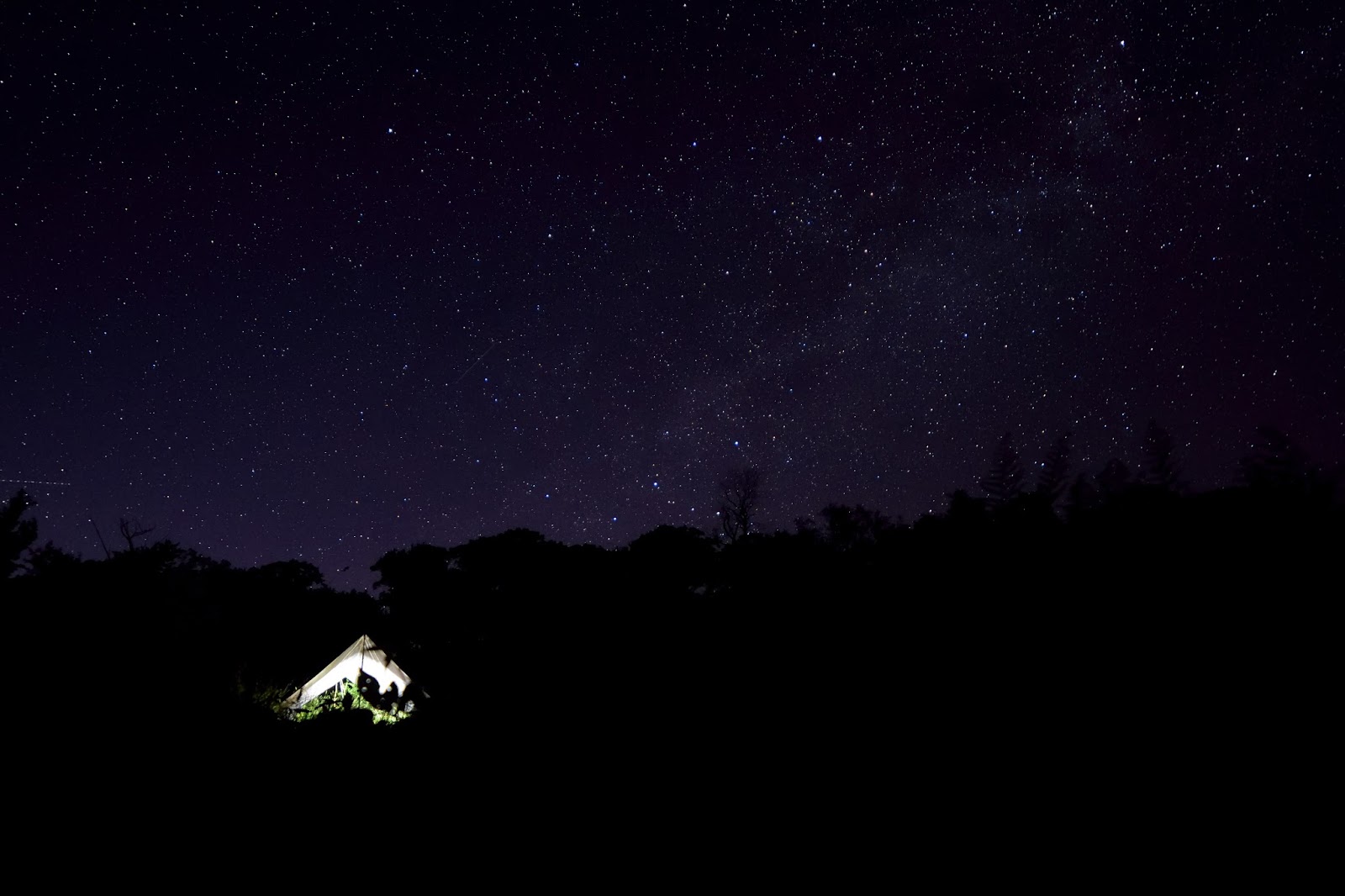
On the afternoon of June 29, I hiked into the Hammersley Wild Area, largest roadless area in Pennsylvania. I know of a few lovely meadows in the Hammersley down near the headwaters of the Hammersely Fork, but on this evening I was headed for higher ground - a clearing that was the site of a 1964 forest fire. (It's well-described in this hike write-up.) The night sky did not disappoint! The moon phase (waning crescent) had the moon below the horizon for most of the night, and the full band of the Milky Way was strikingly bright from horizon to horizon. The Andromeda Galaxy, when it rose, was evident without the least bit of hunting.
I certainly don't consider myself a photographer, but I could not let the trip go without documentation. These images were taken with a Nikon D5300 and a Rokinon 14mm wide angle lens on a mini-tripod. Exposures were 20-25 sec, and raw images were processed with ViewNX 2.
 |
| Looking northeast: Delphinus is over the peak of the tarp. |
 |
| Looking north after darkness falls. |
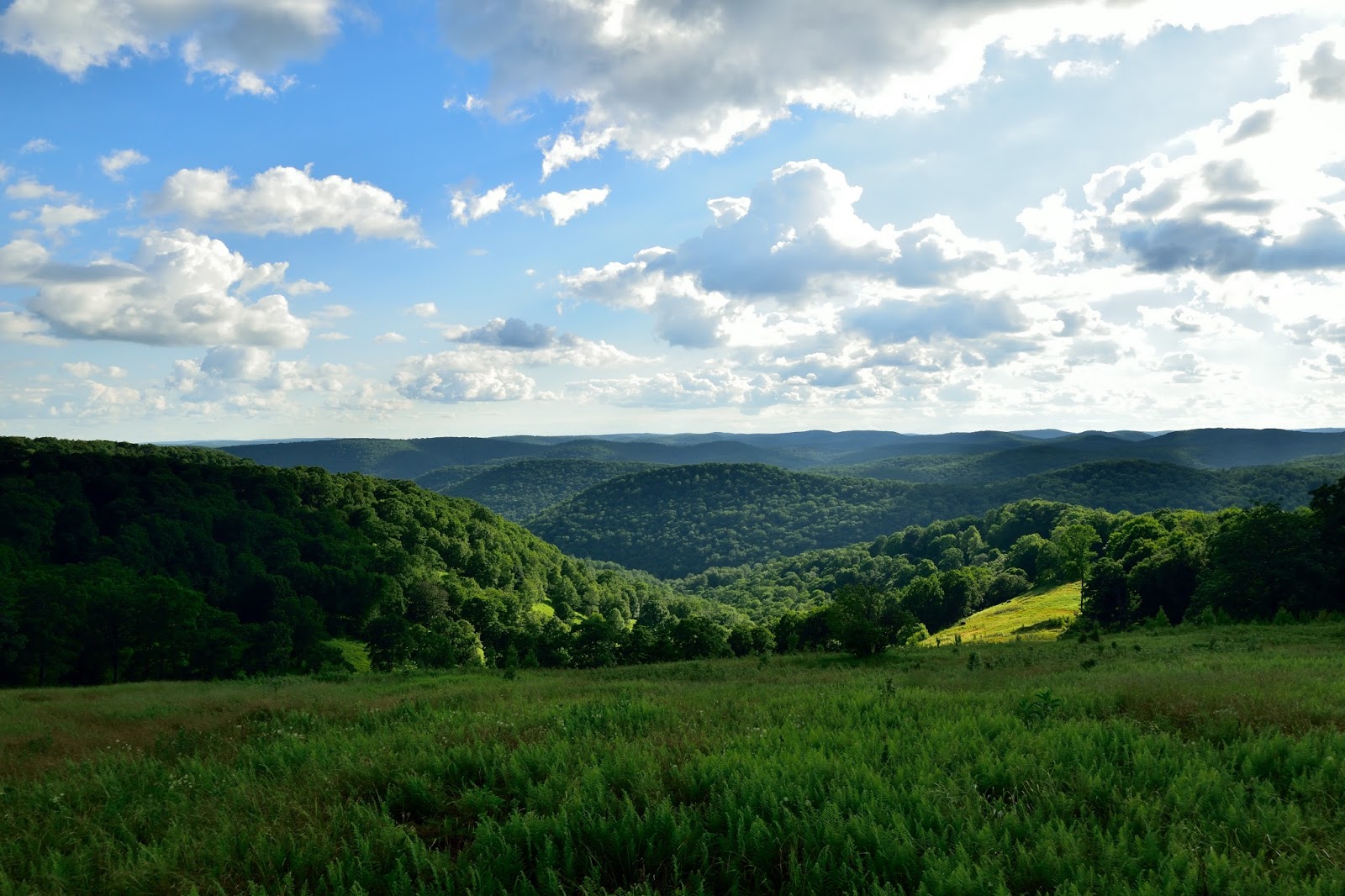 |
| Hammersley Wild Area |
Saturday, July 2, 2016
Renovation Update
Happy July! We've tweeted a few photos of the ongoing work in the planetarium as it's been happening. Here's a summary of the work so far.
On May 1 we gave the last presentation with the 1966 projector. It was a packed house!
Soon after the show planetarium director Ian Clarke and astro professor Jackie Milingo sorted through the materials and extra equipment.
Then Spitz removed the old projector (it's being stored by the Physics Department for potential display) and the contractor completed demolition.
Since then work has been ongoing to turn the space into a its new purpose as a digital planetarium classroom.
The next milestones will be installation of the Spitz SciDome projector and the attendance by six Gettysburg College faculty and administrators at the Spitz Institute, a training and skills development program. By the first day of Fall 2016 classes (August 29) the new Hatter Planetarium will be ready both for public shows and, for the first time ever, as a home for the college's astronomy classes.
On May 1 we gave the last presentation with the 1966 projector. It was a packed house!
Last ride of the A3P! pic.twitter.com/FfoBG2JiNU— Hatter Planetarium (@GCPlanetarium) May 1, 2016
Soon after the show planetarium director Ian Clarke and astro professor Jackie Milingo sorted through the materials and extra equipment.
Renovations already underway! Here's a keepsake from the old #planetarium #hatter2016 #bigbang pic.twitter.com/C2XTJFekxY— Hatter Planetarium (@GCPlanetarium) May 3, 2016
Then Spitz removed the old projector (it's being stored by the Physics Department for potential display) and the contractor completed demolition.
The Hatter Planetarium after a week of demo. #hatter2016 #astronomy #planetarium pic.twitter.com/zsUXHXclQR— Hatter Planetarium (@GCPlanetarium) May 13, 2016
Since then work has been ongoing to turn the space into a its new purpose as a digital planetarium classroom.
Update on progress with architect, facilities, and IT. #Hatter2016 #planetarium pic.twitter.com/f7W06tWbns— Hatter Planetarium (@GCPlanetarium) June 15, 2016
Not a planetary surface! It will be the entryway of our renovated #planetarium #hatter2016 pic.twitter.com/wnTaii7vL3— Hatter Planetarium (@GCPlanetarium) June 27, 2016
The next milestones will be installation of the Spitz SciDome projector and the attendance by six Gettysburg College faculty and administrators at the Spitz Institute, a training and skills development program. By the first day of Fall 2016 classes (August 29) the new Hatter Planetarium will be ready both for public shows and, for the first time ever, as a home for the college's astronomy classes.
Saturday, April 30, 2016
Final Show for Original Projector Tomorrow

It's almost here! I have heard a lot of buzz about this show, so I expect a big audience. It might be a good idea to get to the planetarium early. But not too early! The doors will open at 4:30. When arriving at the College, please be mindful of the fact that we are just beginning final exam week, and students may be studying or testing. Thank you! -IC
Sunday, April 24, 2016
The Last Show

But first, and before we go "from an etch-a-sketch to an iPad," we have the opportunity to make the last doodle with our beloved etch-a-sketch. That chance is this coming Sunday:
"The Sky this Summer"
Sunday, May 1, 5:00 PM
The show will rely 100% on the 1966 projector--no Powerpoint allowed!--and at the end, we'll lower it on its elevator and cover it up. Hope to see you there!
Friday, April 1, 2016
Early April Astrominute
Here is the text of the latest Hatter Planetarium - WZBT astrominute. In addition to the radio station, you may also listen here.
-----
At 8:00 PM Mercury will be just north of west and about 12 degrees
above the horizon. On that evening, it happens that an extremely thin crescent
moon will be just to the left of Mercury. Though the planet is relatively
bright, so is the glow of the sunset, so binoculars may help. A flat and
obstruction-free horizon is a must as well. Of course the sky gets darker as
the minutes pass, but Mercury gets lower, setting about 8:45. At its highest on
April 18, the planet will be 17 degrees above the horizon at 8:00 PM. Good
luck! The astrominute is a production of Gettysburg College’s Hatter
Planetarium and WZBT. Text and images are available on the Gettysburg Skies
blog.
-----
Here is your Gettysburg astrominute for the first half of
April, 2016. On the first of the month, the sun rises at 6:52 AM and does not
set until after 7:30, eastern daylight time. In the first few days of the
month, the moon will be a waning crescent in the predawn sky. A couple days
after the New Moon on April 7, it will emerge into the evening sky as a growing
crescent. It reaches first quarter on April 14th. The planet Jupiter
is dominating the night sky right now. Already high in the east as darkness
falls, it culminates about 60 degrees up in the south at 11:30 PM. Toward the
middle of the month, sky-watchers have the chance to see Mercury, when it will
have its best evening appearance of the year. Go out on clear evenings starting
April 8.
 |
| Mercury and moon, April 8, 8:00 PM |
 |
| April 9, 8:00 PM |
 |
| April 18, 8:00 PM |
Thursday, February 25, 2016
Special Leap Day Astrominute
Sorry, I haven't posted on of these in while. Hope you've been hearing them on WZBT. This one's all about Leap Day - there may be more to it than you think.
MP3 here: http://public.gettysburg.edu/~iclarke/hatter/podcasts/astrominute022516.mp3
Text below:
MP3 here: http://public.gettysburg.edu/~iclarke/hatter/podcasts/astrominute022516.mp3
Text below:
Here is a
special Gettysburg Astrominute for Leap Day. There it sits,
at the bottom of your calendar: February 29. The story of our leap day goes
back to the days of Julius Caesar, who had a problem to solve. The poor Romans,
with their 355-day calendar, had to periodically add days (to February, usually)
to keep their agricultural festivals occurring in the right season. In 46 BC
the Julian reforms regularized the practice to one day every four years. If you
think that’s the system we used today, you’d be wrong. A seasonal year is
actually about 11 minutes less than 365.25 days, and by the 1500s, this error
had added up to ten days. Reforms under Pope Gregory XIII added in the missing
ten days and introduced a couple of tweaks that result in 97 leap days every
400 years - enough that a calendar year and a seasonal year are now practically
the same. The tweaks were to skip leap years in century years, except those divisible by 400. Thus, 1900 was not a leap year, but 2000
was. The new system was adopted right
away in Catholic countries, but not so fast elsewhere. Great Britain and its
colonies held out until 1752. Folks living then, our founding fathers included,
got to decide which birth date to use, old style or new. Russia did not adopt
the reforms until after the 1917 revolution, meaning that, as far as most of
the world was concerned, the October revolution happened in November. The
astrominute is produced by Gettysburg College’s Hatter Planetarium and WZBT.Monday, February 22, 2016
Show Sunday at 4:00 PM
Coming up at the Hatter Planetarium . . .
THE SKY THIS MONTH
Sunday 2/28 at 4:00 PM. The show will feature

THE SKY THIS MONTH
Sunday 2/28 at 4:00 PM. The show will feature
- Leap day and related arcane lore of the calendar
- the opposition of Jupiter
- the vernal equinox
- and FINALLY. . . exciting news about our planetarium!

Sunday, January 24, 2016
Show on Jan 24 is CANCELLED!
Just in case anyone was going to attempt the journey, the show today is cancelled. We are going to stay out of the way while Facilities gets the campus ready for Monday. Stay safe!
Monday, January 18, 2016
Spring 2016 Hatter Planetarium Schedule

It's that time of year. The spring semester is underway and once again we look forward to presenting a monthly sky show in the Hatter Planetarium. Here are two notes about the schedule. First, we'll be doing just one show a month. This seems to fit our audience size the beast, and additionally we have a project in the works that we hope to be able to share with you soon. Second, all shows are on a Sunday at 4:00 PM, except for the one on Sunday, May 1, which is now scheduled for 5:00 PM. This is because your humble planetarium director will be giving a final exam until 4:30, and he really does not want to miss that last show of the year!
We hope to see you for our first show of the semester, this Sunday, January 24, at 4:00 PM. We hope the potential weekend snow is off the sidewalks and parking lots by then. We will be talking about winter stars in the evening sky, planets in the morning sky, and looking ahead to the astronomical highlights of 2016.
You can also see the schedule as a PDF and a Google calendar.
The Sky this Month
February Skies
● Sunday, January 24, 4:00 PM
March Skies
● Sunday, February 28, 4:00 PM
April Skies
● Sunday, April 3, 4:00 PM
Summer Skies
● Sunday, May 1, 5:00 PM*
*Note change: +1 hour due to final
exam schedule.
Friday, December 18, 2015
The Great Christmas Full Moon of 2015!

Here is my take on this year's December 25 full moon. It's expanded from a paragraph that will be appearing in my "What's Up" Gettysburg Times column this month and includes some material from our December planetarium show. --Ian Clarke
One calendrical oddity that may get some press this holiday season is the full moon on Christmas Day, something that you will hear has not occurred since 1977 and will not again until 2034. If nothing else, it’s a great occasion to dig a little deeper into the moon cycle.
The lunar cycle has been a bit troubling to human calendar makers, because at first blush it seems it might fit into the solar year. 12 lunar months make up about 354 days. Unfortunately, if you want to keep track of the seasons of the solar year, an 11-day annual error is a pretty big problem. Our Gregorian calendar is therefore a solar one, with a nod to the lunar cycle in the form of weeks and months. These approximate the moon's quarter and full phase cycle, but not in any way that would actually allow you to keep track of them. The actual phase cycle from one full moon to next is 29.53 days. An average month in our calendar is just under 30.44 days, so a given moon phase slips backward about nine-tenths of a day per month when averaged out over our uneven months.
If you are satisfied with the moon appearing roughly full on Christmas (or any other specific date), you don’t need to wait too long. Any full moon within two or three days will do. The moon was near full on December 25 in 2007 (full the 24th) and 2012 (28th) and will be again in 2018 (22nd) and 2023 (27th).
If on the other hand, you are looking for the moment of full moon to fall exactly on a given date, you must learn about the metonic cycle. As we saw, 12 lunar cycles don't fit evenly into one solar year, but if you wait long enough, you can find a pattern. 235 lunar phase cycles is almost exactly 19 years (6,939.688 days vs.6,939.602 days). Pretty neat! It's called a metonic period. Does that mean a full moon will recur on a given date every 19 years? Almost. Because the match is not exact and because of our leap years, some 19 year intervals are skipped. We have not had a full moon on December 25 in 38 years, so we must have skipped 1996. Then the moon was full on December 24 at 20:41 Universal Time. It missed by a little over three hours. We won’t miss any metonic cycles in the 21st century, so see you, or your heirs, again on December 25, 2034, 2053, 2072, and 2091.
Here is a final complication. Astronomically speaking, the moon is counted as full only for an instant - in this case, December 25 at 11:11 Universal Time. That is 6:11 AM EST, so to see this Christmas full moon in eastern North America, you'll need to be up before sunrise. And in Europe it will be the middle of the day, and the moon, though full, won't even be up. Thinking along those lines, we earthlings did not exactly miss the 1996 Christmas full moon either. When the moon was full on December 24 at 20:41 UT, it was already December 25, local time, in Australia and much of the rest of the Eastern Hemisphere.
Sunday, November 15, 2015
Astrominute for Late November
Below is a text version of the new Gettysburg Astrominute, with some iillustrations. You can listen to the astrominute here and several times a week on WZBT, Gettysburg's address for the best new music!
Here is your
Gettysburg astrominute for late November 2015. The sun rises on Nov 15 at 6:53
AM and sets at 4:53 PM. On the 30th it rises at 7:10 and sets at
4:45. The moon phase will be growing during most of the two week period – starting as a waxing
crescent, reaching first quarter on the 19th and full on the 25th.
The Leonid meteor shower will be peaking on Nov 17 to 18. Go out from midnight
to dawn on either morning and you may see up to 10-15 meteors per hour. And
while you’re up early, check out the bright planets in the east before sunrise.
Jupiter is now the highest, with Mars, and then Venus below it. Venus is the
brightest; next Jupiter and then Mars. Let’s not neglect the evening sky. The
bright star Capella and the Pleaides (or 7 sisters) star cluster are both
rising in the east around dark. Aldebaran, the eye of Taurus the Bull, follows
about an hour later. Then the familiar constellation Orion the Hunter will be
entirely up by 9 PM. The astrominute is
produced by Gettysburg College’s Hatter Planetarium and WZBT 91.1 FM. For a text version of the
astrominute, with illustrations, visit the Gettysburg Skies blog.
 |
| 5:30 AM on November 20 |
 |
| 9:30 PM on Nov 20 |
Friday, October 16, 2015
Late October Astrominute
 |
| Julia Giannini reads the latest Astrominute |
***
Here is your
Gettysburg astrominute for late October 2015. The sun is now setting before
6:30 PM Daylight Time, but be ready for that to jump back an hour when we
switch to Standard Time on November 1. The moon is prominent right now--first
as a waxing crescent in the western evening sky but reaching first quarter on
Oct 20 and Full on the 27th. There are no bright planets in the
evening right now, but to compensate there’s a great show going on in the
predawn sky, where you can see Venus, Jupiter, Mars, and even Mercury. Get
outside around 6:30 AM to a place with a flat eastern horizon. Venus will be by
far the brightest thing you see in the east. In the middle of the month, it is
also the highest, but that will change. Below Venus and a bit left are Jupiter
and Mars, with Jupiter the brighter of those two. You might also see Mercury
just a few degrees above the eastern horizon. By the last week of the month,
Mercury will drop from sight, but watch as Jupiter and Mars close the gap with
Venus. On the 25th and 26th, Venus and Jupiter will be as
close as the width of a finger at arm’s length. Then in the first days of
November it will be Venus and Mars in conjunction, with Jupiter a few degrees
above them. We hope you can get up early and enjoy the sight! The astrominute
is a production of Gettysburg College and WZBT.
***
Here are some helpful illustrations for our location, created with Stellarium. The first shows the view, looking east, on Oct 17 at 6:30 AM. Grid lines are 10 degrees (about a fist-width) apart.

In the view below, on the morning of the 25th, Mars and Jupiter have moved higher while Venus is holding fairly steady. Jupiter catches up to Venus while Mars is just below.

In the final scene, November 3 at 5:30 AM (note the switch back to standard time) Mars catches up to Venus while Jupiter is above. Both planets will be plainly visible, but at magnitude -4.3 compared to Mars's 1.7, Venus will be much brighter. How much brighter? Each magnitude is 2.5 brighter than the next higher one, so about 250 times brighter!
2.5^(1.7 - -4.3) = 244.14

Sunday, October 4, 2015
"Remnants," Time-lapse by Nate Atwater, '14
Remnants from Nate Atwater on Vimeo.
Here is the wonderful video by recent grad Nate Atwater, that we featured in the October show.He made it with his brother over two weeks living out of a Ford Escape. Nate says he planned the sequences "using a compass and some basic orienteering skills I learned from GRAB and astronomy 101 with Prof. Johnson."
Here is the wonderful video by recent grad Nate Atwater, that we featured in the October show.He made it with his brother over two weeks living out of a Ford Escape. Nate says he planned the sequences "using a compass and some basic orienteering skills I learned from GRAB and astronomy 101 with Prof. Johnson."
Friday, October 2, 2015
Early October Astrominute
 Below is a text version of the new Gettysburg Astrominute, with some iillustrations. You can listen to the astrominute here and several times a week on WZBT.
Here is your
Gettysburg astrominute for the first half of October, 2015. On October 8 (the
middle of our astrominute period) the sun will rise at 7:12 and set at 6:41,
eastern daylight time. The moon will not be in the evening sky – it reaches Last
Quarter on October 4 and New on the 13th. As it gets dark, the
Summer Triangle is overhead, dominating the sky. Meanwhile, look for the Great
Square of Pegasus in the east. [Check out www.skymaps.com for a downloadable monthy map.]
The best show right now, however, is in the
morning sky. Venus stands brilliantly in the east before sunrise, and below it
the planet Jupiter is coming into view. Though fainter, Mars and the star
Regulus are both nearby. Better yet, the waning crescent moon will be passing
through on the 8th through the 10th. Look for the
crescent moon, 17% illuminated, near Venus on the 8th.
As it gets
closer to the sun each morning, it will be near Jupiter and 11% illuminated on
the 9th, and below Jupiter and only 6% illuminated on the 10th.
That is still 70 hours before new moon on the 13th, so quite visible
if you go out before 6AM. If you’re an early riser, you might also notice that
Jupiter and Venus are drawing close together. They will be very close indeed at
the end of the month. More on that next time. The astrominute is a production
of Gettysburg College’s Hatter Planetarium and WZBT. For a text of the
astrominute, with illustrations, visit the Gettysburg Skies Blog.
 |
| 10/8, 5:45 AM. 10 deg. = fist at arm's length. |
Images created with Stellarium.
 |
| 10/9 |
 |
| 10/10. |
Subscribe to:
Posts (Atom)